Hafiz Alam Sairani
Honoring the legacy
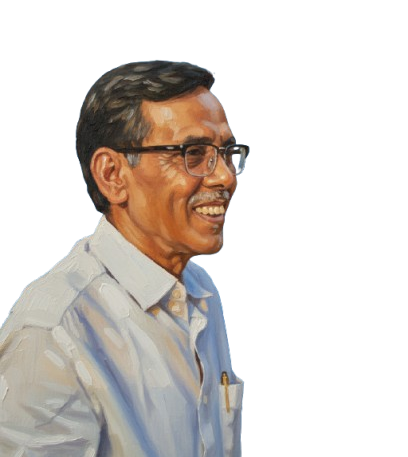
" I can offer you nothing but my name.
If you mention it anywhere, people will come to your aid."
Life & legacy
A name by mistake:
Hafiz Alam Sairani – The name "Sairani" is a mistake, caused by a typo. His original name was Hafiz Alam. The name “Hafiz” is an Arabic name that means "one who remembers" or "keeper". It can also mean "guardian", "one who guards", or "a caring protector" and the name “Alam” is a masculine name that means "world" or "universe". During his school years, his teacher added the word "Sailaani," meaning traveler, to his name, so it became Hafiz Alam Sailaani. However, when the school submitted the form for his 10th exam, "Sailaani" was mistakenly recorded as "Sairani."
_edited.jpg)
Early Life:
Sairani was born into a well-off family on February 1, 1960, a Monday, just before sunset in Binardah, Chakulia, Uttar Dinajpur, West Bengal. His father, Mohammad Kalimuddin, was known as "Md. Kalu," a nickname that later became his common identifier. Md. Kalu was a Zamindar and was well-respected in the region. Sairani was the youngest child of Md. Kalu and Halimun Nisha, among their three sons and two daughters.
Binardah, where Sairani spent his formative years. This picturesque village, with its lush fields and rural charm, shaped much of his early life. Growing up in a family deeply rooted in agriculture, Sairani was intimately connected with the rhythms of farm life, which was a daily routine in Binardah. The village was primarily dependent on farming, and Sairani learned the importance of hard work, dedication, and the nurturing of the land from a young age.
Fishing, a favorite pastime, allowed him to explore the nearby rivers and ponds, further grounding him in the local culture and way of life. His father, a well-respected figure in the village, played a pivotal role not just in the family but also within the community. Known for his wisdom, he often mediated conflicts and helped resolve disputes, earning the respect and admiration of the villagers.
Tragedy struck Sairani at a young age when he lost his mother, leaving him to rely heavily on his father. However, when his father unexpectedly passed away while Sairani was still in school, his brothers stepped up. They assumed the responsibility of raising him, ensuring that he received the education his father had always hoped for, despite the hardships that came with the sudden loss.
Education:
Although Sairani's father, Md. Kalu, had no formal education, he was literate in Bengali, Hindi, and Urdu. Md. Kalu never had the opportunity to attend school because his own father passed away when he was only three years old. However, he was deeply committed to providing better educational opportunities for his sons, driven by his belief in the importance of education. As a result, Hafiz's elder brother, Ramzan Ali, became the first person from the region to study law at Patna University. His other brother, Md. Aslam , was a teacher with a strong command of the English language. Sairani himself went on to earn master’s degrees in Commerce from Calcutta (Kolkata) University.
Sairani began his primary education in Binardah and later enrolled at Manora High School. A few years later, he was transferred to Chakulia High School. He also studied at St. Paul’s School in Darjeeling for a few years before his father's sudden passing. Afterward, he transferred to Islampur High School. He completed both his graduation and master's degrees in Commerce from Calcutta University, later earning a B.Ed from Govt. Teachers’ Training Collage Malda, West Bengal.
Profession:
Sairani began his career as a teacher at Chakulia High School. As a child, he had developed a keen interest in education and later attained a degree in B.Ed. Despite having many job opportunities, Sairani chose to become a teacher at Chakulia High School, where he had once studied. He took voluntary retirement at the age of 46 in 2006 to pursue his passion for serving the common people.

Early Political Involvement:
Sairani grew up in a family where he witnessed firsthand how influential his father was in resolving land disputes, family issues, and administrative problems for the local community. His elder brother, Ramzan Ali, became involved in politics from his student days. Ramzan was devoted to fighting for the rights of the oppressed and took a strong stance against the many challenges faced by the people of Islampur subdivision in Uttar Dinajpur district, who often felt mistreated by the government. Ramzan Ali became a savior to many helpless individuals.
Ramzan Ali’s political journey was marked by his unwavering commitment to speaking out against the mistreatment of the people, even at the cost of being arrested multiple times. His dedication led him to serve as an MLA for 17 years, a remarkable achievement. In his first election as an independent candidate, he triumphed over 16 other contenders, all of whom lost their deposits (Zamanat Zabt). This victory was significant, not only for his success but also for the love and devotion he earned from his fight for the common people.

Growing up in a politically charged environment, Sairani developed an interest in politics at a young age. His first direct involvement occurred during the JP movement while he was pursuing his higher secondary education at Islampur High School. He was arrested for his active participation in the movement.
Path to Organizational Leadership:
While pursuing his graduation, Sairani immersed himself fully in student politics in Kolkata. In 1980, Ramzan Ali joined the All India Forward Bloc, and Sairani followed his path, joining the same party. He emerged as an organizational leader by effectively managing the political affairs of his brother's constituency. His involvement in these activities helped him build a strong reputation and gain significant popularity, which later played a crucial role in his success within the Goalpokhar constituency.
From Family’s Tragedy to Family Success:
In 1994, Sairani faced a tragedy that echoed the loss he had endured as a child when his elder brother, Ramzan Ali, was murdered in Kolkata. Despite being the youngest in the family, he stepped up to play a crucial role in holding the family together. Overnight, he became the center of responsibility, taking care of his ailing brother Aslam, Ramzan’s three children, and his own family, which included his young child. The emotional toll was immense, but Sairani managed the situation with resilience. He ensured that all the children under his care received a quality education, no matter how difficult the circumstances were.
Ramzan's son went on to complete his LLB and followed in the footsteps of his father and uncle, choosing a career in politics. He served as an MLA for three consecutive terms. Ramzan’s younger daughter became a lawyer and is now practicing at the Delhi High Court. Sairani’s son completed his MBA and currently works in a private firm, also pursuing a career in politics. Hafiz’s daughter earned a Master’s degree in Microbiology and now works as a research analyst for a renowned multinational company. Through immense sacrifice and determination, Sairani played a pivotal role in shaping the futures of his family members, ensuring they thrived despite the challenges they faced.
By-Election Candidate to Three-Term MLA:
After Ramzan Ali’s death, Sairani stepped up, taking on his responsibilities with resilience and dedication. Following Ramzan's passing, the party selected Sairani as their candidate for the upcoming by-election. He went on to serve as an MLA for three consecutive terms. Throughout his tenure, he earned immense respect for his honesty and integrity. Despite his long political career, he never exploited his power for personal gain.

A Visionary in Relief and Cooperative Governance:
In 2001, Hafiz Alam Sairani was appointed as a Cabinet Minister in the Buddhadeb Bhattacharjee government of West Bengal, overseeing the Relief Department. He became the first-ever Cabinet Minister from the Islampur Sub-Division in Uttar Dinajpur. His remarkable work as Relief Minister included taking decisive action to strengthen the river banks in Itahar, Malda, and Murshidabad, effectively mitigating the risk of floods. He dedicated his time to preparing for any potential disasters in the state, ensuring that the necessary precautions were in place. He was always quick to visit the affected areas as soon as possible to assess the situation and provide support. In 2004, when the tsunami struck India and severely affected South India, Sairani was among the first to step forward. He donated his entire ministry allowance for the relief efforts in the tsunami-affected areas, demonstrating his commitment to supporting those in need during such a devastating crisis. By the time he had proven his abilities as Relief Minister, the government decided to assign him control of another major department, the Cooperative Department, in the West Bengal government. He effectively managed his role as Cooperative Minister as well, continuing to deliver impactful results in his new position.
Advocacy for Minorities:
Sairani's significant role for minorities is unforgettable. He was the only one who opposed the POCA Bill (2002) in the Cabinet meeting. He did not support the bill because he understood its potential impact on minorities, especially Muslims. He even offered to resign from the Cabinet of Buddhadeb Bhattacharjee in protest.
When the Sachar Committee Report was made public in 2006, he actively advocated for a separate quota for minorities. He to raise this demand at the Left Front meeting. Following this, the government became open to the idea of implementing such a policy. He was the one who brought forward the demand for granting government recognition to Madrasas. The government accepted this proposal and began taking steps to implement it.

Leadership, Organizational Excellence, and Advocacy for New Talent:
In 2006, he lost the election.. However, due to his exceptional organizational skills, Ashok Ghosh appointed him as a member of the Left Front Secretariat. He also held several important positions within the AIFB. Sairnai also appointed as President of All India Agragami Kisan Sabha. Initially, he served as the Secretary of the Uttar Dinajpur AIFB, and later, he was appointed to the state secretariat. Ashok Ghosh began grooming him for more significant roles within the party. Sairani strongly advocated for the inclusion of new faces in politics. Under his leadership, fresh talent was introduced to both the organization and the electoral arena. Many local leaders were appointed to the state secretariat, and a few were nominated for MLA and MP elections based on his recommendations.
The Nandigram Tragedy of 2007, A Struggle for Justice and Political Mediation:
In 2007, Nandigram became the center of national attention when 14 people were killed in a brutal police firing. Sairani emerged as a key figure during this tragic period, staunchly supporting the people of Nandigram in their fight against the Left Front-led government. His unwavering commitment to their cause culminated when the All India Forward Bloc (AIFB) organized a major rally in Nandigram, condemning the police violence and demanding justice. Sairani’s efforts to stand alongside the residents of Nandigram during this critical time helped amplify their voices in the face of government repression. Ashok Ghosh worked to ease the growing tension between the Left Front government and the then opposition party, Trinamool Congress (TMC). To facilitate a resolution, Hafiz was tasked with persuading Mamata Banerjee, the President of TMC, to attend a crucial meeting where both parties could come to a conclusion. In this scenario, Ashok Ghosh acted as the intermediary, bridging the gap between the CPIM and TMC to help resolve the conflict.
Struggle Within the Party:
After Ashok Ghosh's death, significant changes took place within the party. Ghosh had been grooming and mentally preparing Sairani to take over as General Secretary. However, following his death, Sairani found himself cornered within the party. As tensions rose and the situation spiraled out of control, Sairani gradually distanced himself from party involvement.

Political Transition:
He remained with the All India Forward Bloc until 2022 when he joined the Indian National Congress on November 3, 2022. He was subsequently appointed Vice President of the Indian National Congress West Bengal Committee on February 21, 2023.
Passing of Sairani:
On October 13, 2024, Sairani was admitted to Apollo Hospital in Kolkata after complaining of pain in his right ankle. Subsequent tests revealed that he was suffering from lung cancer, leading to his transfer to SSKM Hospital for specialized treatment. Sadly, on October 28, 2024, at 1:30 PM, he passed away.
